Pain after hip or knee replacement is normal. Although surgery removes the damaged joint surfaces responsible for arthritis pain, the surrounding muscles, tendons, ligaments, and other tissues still need time to heal.
Fortunately, modern joint replacement surgery uses several different methods to control pain and make recovery more comfortable.
The goal of pain management is not to eliminate every bit of discomfort. It is to keep your pain manageable so you can walk, participate in therapy, sleep, and gradually return to your normal activities.
One of the most important things to understand is that pain and swelling are closely connected. Managing swelling through proper elevation, icing, and appropriate activity is just as important as taking your prescribed medications.
What Should I Expect After Surgery?
Every patient's recovery is different. Some patients experience relatively little discomfort, while others have more significant pain during the first several weeks.
In general:
The First 24–48 Hours
You may initially have excellent pain relief from the anesthesia and nerve blocks used during surgery.
As these medications wear off, discomfort may increase. This is expected and does not necessarily indicate a problem.
Days 2–5
For many patients, pain and swelling become more noticeable during the first several days after surgery.
This is often when the initial effects of anesthesia have completely worn off and postoperative inflammation is increasing.
Staying consistent with your prescribed medications, icing, and elevation can help make this period more manageable.
Weeks 1–2
Pain should generally begin improving, although soreness, swelling, bruising, and stiffness remain common.
You may notice increased discomfort after walking, physical therapy, or spending too much time on your feet.
Weeks 3–6
Most patients experience continued improvement in pain and mobility.
However, swelling, stiffness, and occasional discomfort can persist, particularly after knee replacement.
Beyond Six Weeks
Most patients continue to improve over several months.
Some residual swelling, stiffness, and soreness can persist during this time, especially after more strenuous activity.
Remember: Recovery is not always a straight line. Having a more uncomfortable day after increased activity does not necessarily mean something is wrong.
However, pain that is progressively worsening rather than gradually improving should be discussed with your surgical team.
How Do We Control Pain After Joint Replacement?
Modern joint replacement surgery uses a strategy called multimodal pain management.
This means using several different treatments that work together to control pain.
Rather than relying entirely on strong narcotic medications, we combine:
- Spinal anesthesia and regional nerve blocks when appropriate.
- Local anesthetic medications administered around the surgical site.
- Nonopioid pain medications.
- Anti-inflammatory medications.
- Opioid medications when needed for breakthrough pain.
- Icing, elevation, and swelling control.
- Appropriate movement, exercise, and rest.
Using several different methods helps improve comfort while reducing reliance on opioid medications.
My Standard Surgical Pathway
For knee replacement, I typically use spinal anesthesia, an adductor canal nerve block, and a RECK periarticular injection (pain medicine placed around the joint). I do not use a tourniquet or a postoperative drain in my standard knee replacement pathway.
For hip replacement, I typically use spinal anesthesia, a fascia iliaca nerve block, and a RECK periarticular injection around the joint.
These methods work together to improve comfort and reduce the amount of opioid medicine you may need. Your anesthesia and surgical plan may be adjusted for your health and needs.
Your specific medications may differ depending on your medical history, allergies, kidney function, and other individual considerations.
Understanding Your Pain Medications
Several medications may be prescribed after surgery. Each serves a different purpose. These doses are examples of my practice’s typical prescriptions, not instructions for every patient. Do not independently change medications prescribed for other conditions; ask your surgical team or prescribing clinician.
Always follow the medication instructions provided at discharge. Your individual prescriptions may differ from the examples below.
Acetaminophen (Tylenol)
Typical regimen: 1,000 mg three times daily
Acetaminophen is an important part of baseline pain control.
It helps reduce pain without many of the side effects associated with opioid medications.
Taking it regularly during the early recovery period can help maintain more consistent pain relief.
Important:
- Do not take additional Tylenol or combination medications containing acetaminophen without checking your total daily dose.
- The typical regimen above totals 3,000 mg per day.
- Patients with liver disease or certain other medical conditions may require a lower dose.
Celecoxib (Celebrex)
Typical regimen: 200 mg twice daily
Celecoxib is an anti-inflammatory medication.
Inflammation contributes to postoperative pain and swelling, so controlling inflammation can improve comfort during recovery.
Celecoxib works differently from acetaminophen, which is why the two medications are often used together.
Important:
- Do not take additional anti-inflammatory medications such as ibuprofen (Advil or Motrin) or naproxen (Aleve) unless specifically instructed.
- Celecoxib may not be appropriate for patients with certain kidney problems, gastrointestinal bleeding risks, cardiovascular conditions, or medication interactions.
- Follow your discharge instructions regarding how long to take it.
Oxycodone
Typical regimen: 5 mg every six hours as needed for pain
Oxycodone is an opioid pain medication used for breakthrough pain.
Breakthrough pain is discomfort that remains significant despite your other pain-control measures.
You do not need to take oxycodone every six hours if your pain is adequately controlled.
The goal is to use the lowest effective amount for the shortest necessary period.
Common side effects include:
- Constipation.
- Nausea.
- Drowsiness.
- Dizziness.
- Confusion.
Opioids can also slow breathing, particularly when combined with alcohol, sleeping medications, muscle relaxants, or certain other prescriptions.
Do not drive while taking oxycodone.
Store opioid medications securely and never share them with another person.
Gabapentin (Neurontin)
Sometimes prescribed: 100 mg three times daily
Gabapentin is occasionally used as an additional pain medication in selected patients.
It is not necessary for everyone undergoing joint replacement.
Gabapentin can cause dizziness, drowsiness, and balance difficulties. These effects may be more pronounced in older adults or when combined with opioid medications.
Gabapentin is used selectively, not routinely. Dizziness and sedation increase the risk of falls. Combining gabapentin with opioids can also increase the risk of dangerously slow breathing. Only take gabapentin if it has been specifically prescribed to you.
Muscle Relaxants
Some patients experience significant muscle spasms after surgery.
When these occur, a muscle relaxant may occasionally be prescribed.
Muscle relaxants are not routinely necessary after joint replacement.
Because they can cause drowsiness, dizziness, and weakness, they should only be taken as directed. Take precautions against falls and ask for help when walking if you feel unsteady.
The First Few Weeks: Controlling Pain and Swelling
Swelling is a normal part of healing after hip or knee replacement.
However, swelling can also contribute significantly to pain, stiffness, and difficulty moving your new joint.
This is particularly noticeable after knee replacement, where swelling can make bending and straightening the knee more difficult.
One of the most important things you can do during the first several weeks is actively manage swelling.
Medication is only one part of that process.
1. Elevate Your Leg — Properly
Elevation helps fluid move away from the operated leg.
However, there is an important difference between simply putting your feet up and properly elevating your leg.
Sitting upright in a recliner with your feet resting on the footrest is not the same as elevating your leg above your heart.
How to Elevate Correctly
- Lie flat on your back.
- Place pillows or a supportive wedge beneath your operated leg.
- Raise your ankle and foot above the level of your heart.
- Keep your leg comfortably supported.
- Remain elevated for approximately 30–60 minutes at a time, several times throughout the day, as tolerated.
The suggested 30–60-minute sessions are practical guidance, not a scientifically established optimal elevation schedule. Follow your surgical team’s positioning instructions and any hip precautions.
For knee replacement patients, avoid keeping a pillow directly beneath the knee for prolonged periods.
Your knee needs to regain the ability to straighten completely. Support your leg in a position that allows the knee to remain straight rather than bent.
Remember: Your foot should be above your heart, not simply above the floor.
Correct Versus Incorrect Elevation
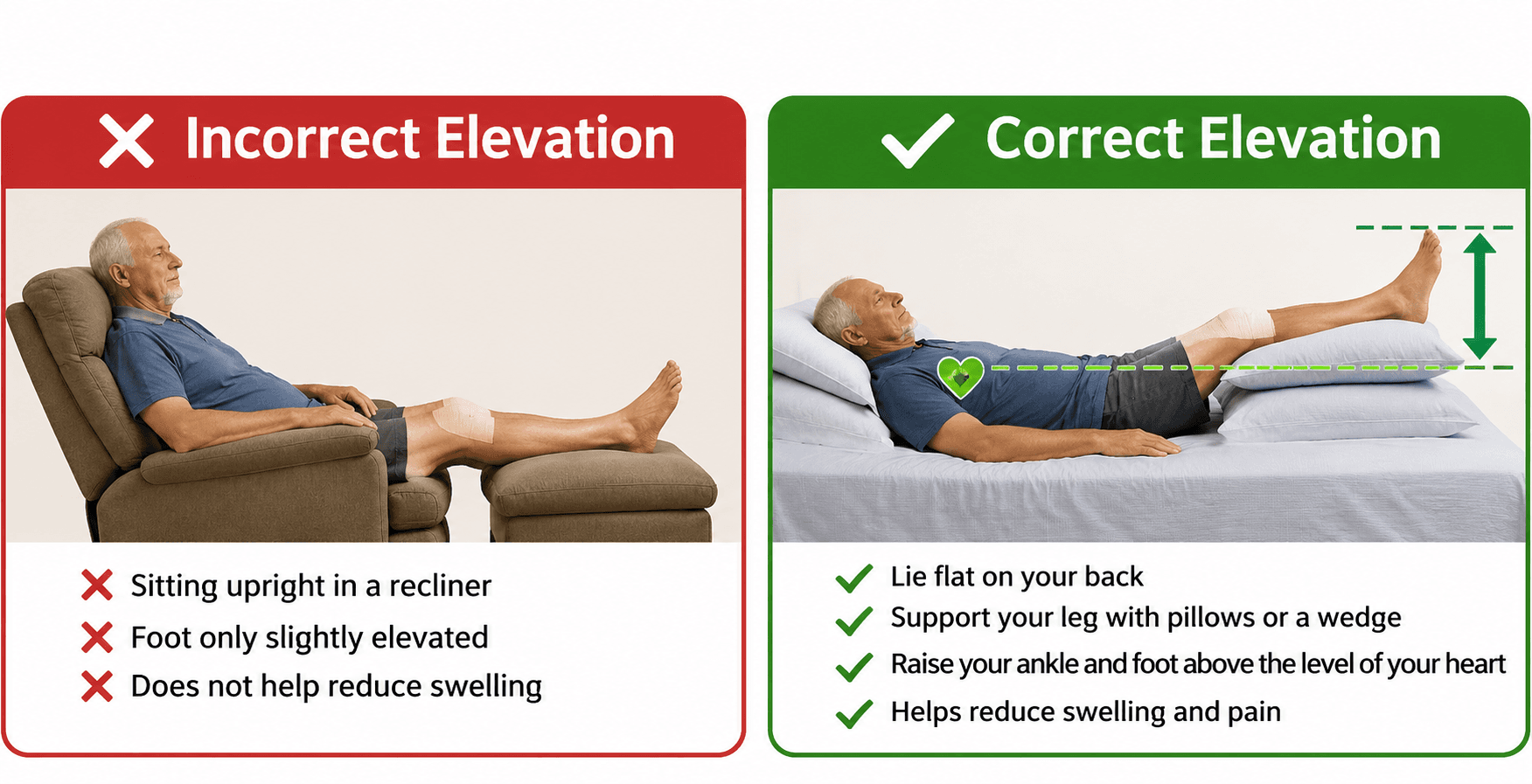
Clarification: Some elevation in a recliner may help. The left position is less effective for swelling control; raising the foot above heart level is preferred when practical. Despite the bend shown in the illustration, keep your knee relatively straight and support the calf and ankle rather than leaving a pillow directly behind the knee.
Proper elevation involves lying back with the operated leg supported above heart level. Simply resting your foot on a recliner or ottoman does not provide the same degree of elevation.
2. Ice Frequently
Cold therapy is one of the simplest ways to help manage discomfort after surgery.
Icing can reduce pain and may help with swelling.
During the first two weeks, use ice regularly, particularly after walking or completing your exercises.
How to Ice Safely
- Apply a cold pack for approximately 15–20 minutes at a time.
- Always place a thin towel or protective barrier between the cold pack and your skin.
- Repeat several times throughout the day.
- Consider icing after physical therapy or periods of increased activity.
- If you were provided a circulating cold therapy device, follow the specific instructions for that device.
Never apply ice directly to your skin.
Do not fall asleep with an ice pack in place.
Be especially careful if you have reduced sensation around the surgical site.
A helpful routine is to ice your joint while your leg is properly elevated.
3. Walk Frequently — But Don't Overdo It
Walking is essential after joint replacement.
It helps improve circulation, maintain mobility, and reduce the risk of blood clots.
However, excessive walking or standing during the first few weeks can increase swelling and discomfort.
Short, frequent walks are generally better than one long walk.
During early recovery:
- Walk short distances around your home several times daily.
- Use your walker or other prescribed assistive device.
- Gradually increase activity as your comfort and mobility improve.
- Avoid spending long periods standing or walking simply to accelerate recovery.
- Rest, ice, and elevate between periods of activity.
You do not need to walk continuously or spend the entire day on your feet to recover successfully.
If your leg becomes significantly more swollen or painful after activity, you may be doing too much.
Temporarily reduce your activity and allow time for recovery.
4. Balance Physical Therapy With Rest
Physical therapy and home exercises are important parts of recovery.
This is especially true after knee replacement, where restoring motion is a major priority.
However, more exercise is not always better.
The goal is steady progress over time.
Complete your prescribed exercises and participate in therapy, but avoid repeatedly forcing your joint through severe pain.
After exercise, allow time for icing, elevation, and rest.
For knee replacement patients, swelling can make the knee feel tight and limit motion. Managing swelling may make your exercises more comfortable.
Your therapist and surgical team can help determine the appropriate amount of activity for your stage of recovery.
5. Expect Some Good Days and Bad Days
Recovery rarely progresses at exactly the same pace every day.
You may feel excellent one morning and experience increased soreness that evening.
Often, this happens after increasing your walking, standing, or exercises.
When discomfort increases:
- Consider whether you have been more active than usual.
- Reduce unnecessary activity temporarily.
- Ice the joint.
- Elevate the leg properly.
- Continue your prescribed pain medications as directed.
Mild fluctuations in discomfort are common.
However, new severe pain, rapidly increasing swelling, or progressively worsening symptoms should not automatically be attributed to overactivity.
How Long Will I Need Pain Medication?
The amount of pain medication needed after surgery varies considerably between patients.
Many patients begin reducing opioid medication during the first several days to weeks as discomfort improves.
Some patients require medication longer, particularly after knee replacement.
The important thing is to reduce opioid use as your pain becomes more manageable.
You may find that you no longer need oxycodone during the day but occasionally need it at night or around physical therapy.
Others may stop using opioids entirely relatively early in recovery.
You do not need to take an opioid simply because it was prescribed.
Continue other prescribed medications according to your discharge instructions. If you have been taking opioids regularly for an extended period, discuss a gradual reduction plan with your surgical team rather than stopping abruptly.
Common Questions About Pain After Joint Replacement
Is knee replacement more painful than hip replacement?
Many patients experience more prolonged discomfort and stiffness after knee replacement than after hip replacement.
The knee often develops substantial swelling, which can make bending, straightening, and walking uncomfortable.
However, every patient is different, and some hip replacement patients experience significant postoperative pain as well.
Why does my pain get worse at night?
Nighttime discomfort is common during the first several weeks.
Swelling and soreness may accumulate throughout the day, particularly after walking or therapy.
There are also fewer distractions at night, making discomfort more noticeable.
Icing and properly elevating your leg before bedtime may help.
Should I take oxycodone before physical therapy?
Not necessarily.
If your pain is adequately controlled without oxycodone, there is no reason to take it simply because you have a therapy appointment.
If pain significantly limits your ability to participate, discuss medication timing with your surgical team.
Remember that oxycodone can cause dizziness and drowsiness, increasing your risk of falling.
Is it normal for my leg to swell after walking?
Yes. Increased swelling after activity is common during early recovery.
Swelling often becomes more noticeable later in the day or after spending time on your feet.
However, swelling should generally improve with rest and elevation.
New, substantial, or rapidly worsening swelling—especially when accompanied by calf pain—requires medical evaluation.
Should I push through pain to regain motion?
Some discomfort during rehabilitation is expected.
However, repeatedly forcing your joint through severe pain is not necessary and may aggravate swelling.
Work toward gradual improvement and follow the exercises recommended by your therapist and surgeon.
How long should I continue icing and elevating?
Icing and elevation are particularly helpful during the first two weeks, when postoperative discomfort and swelling are often most noticeable.
However, many patients continue benefiting from these measures for several additional weeks.
You can gradually reduce their frequency as swelling and discomfort improve.
When Should I Contact My Surgical Team?
Although pain and swelling are expected after surgery, certain symptoms deserve prompt attention.
Contact your surgical team if you experience:
- Pain that is progressively worsening rather than gradually improving.
- New severe pain or sudden difficulty bearing weight.
- Increasing redness, warmth, or drainage around your incision.
- Fever of 101°F or higher, or persistent fever with other concerning symptoms.
- New or significant calf pain or swelling.
- Rapidly increasing swelling that does not improve with rest and elevation.
- Pain that remains uncontrolled despite following your prescribed treatment plan.
- Medication side effects that make it difficult to stay awake, walk safely, eat, or drink.
Call 911 immediately if you experience chest pain, sudden shortness of breath, fainting, or severe difficulty breathing.
Call 911 for suspected opioid overdose, including extreme sleepiness, inability to awaken normally, or slow breathing after opioid medication.
Your Daily Recovery Routine
During the first few weeks, a simple routine can help you balance movement with recovery.
WALK → EXERCISE → ICE → ELEVATE → REST
Walk: Take short, frequent walks using your prescribed assistive device.
Exercise: Complete your recommended home exercises or physical therapy.
Ice: Use cold therapy to help relieve discomfort after activity.
Elevate: Lie back and raise your operated leg above heart level to help manage swelling.
Rest: Allow your body time to recover before your next period of activity.
Repeat this cycle throughout the day as appropriate for your recovery.
The goal is not to do as much as possible every day. It is to make steady progress without unnecessarily increasing pain and swelling.
Key Takeaways
- Some pain and swelling are normal after hip or knee replacement.
- Modern pain management uses several different medications and techniques to improve comfort while limiting opioid use.
- Take your medications exactly as prescribed. Oxycodone is generally reserved for breakthrough pain.
- Proper elevation means getting your ankle and foot above the level of your heart.
- Ice regularly, especially after activity.
- Walk frequently, but avoid overdoing it.
- Balance physical therapy with adequate rest and swelling control.
- Expect gradual improvement rather than a perfectly smooth recovery.
- Contact your surgical team if pain or swelling becomes progressively worse or you develop concerning symptoms.
Successful recovery requires a balance between movement and rest.
Staying mobile, taking medications appropriately, controlling swelling, and allowing your body time to heal can make the first several weeks after joint replacement significantly more manageable.
You cannot rush the healing process by doing more.